Poor attribution and reporting
A/B test anything, then see the incremental lift
Maestra Platform is the all-in-one marketing personalization platform where ecommerce brands branch flows to find winning channels, offers, and segments, then measure incremental lift with control groups.
Brands running on Maestra






The problem
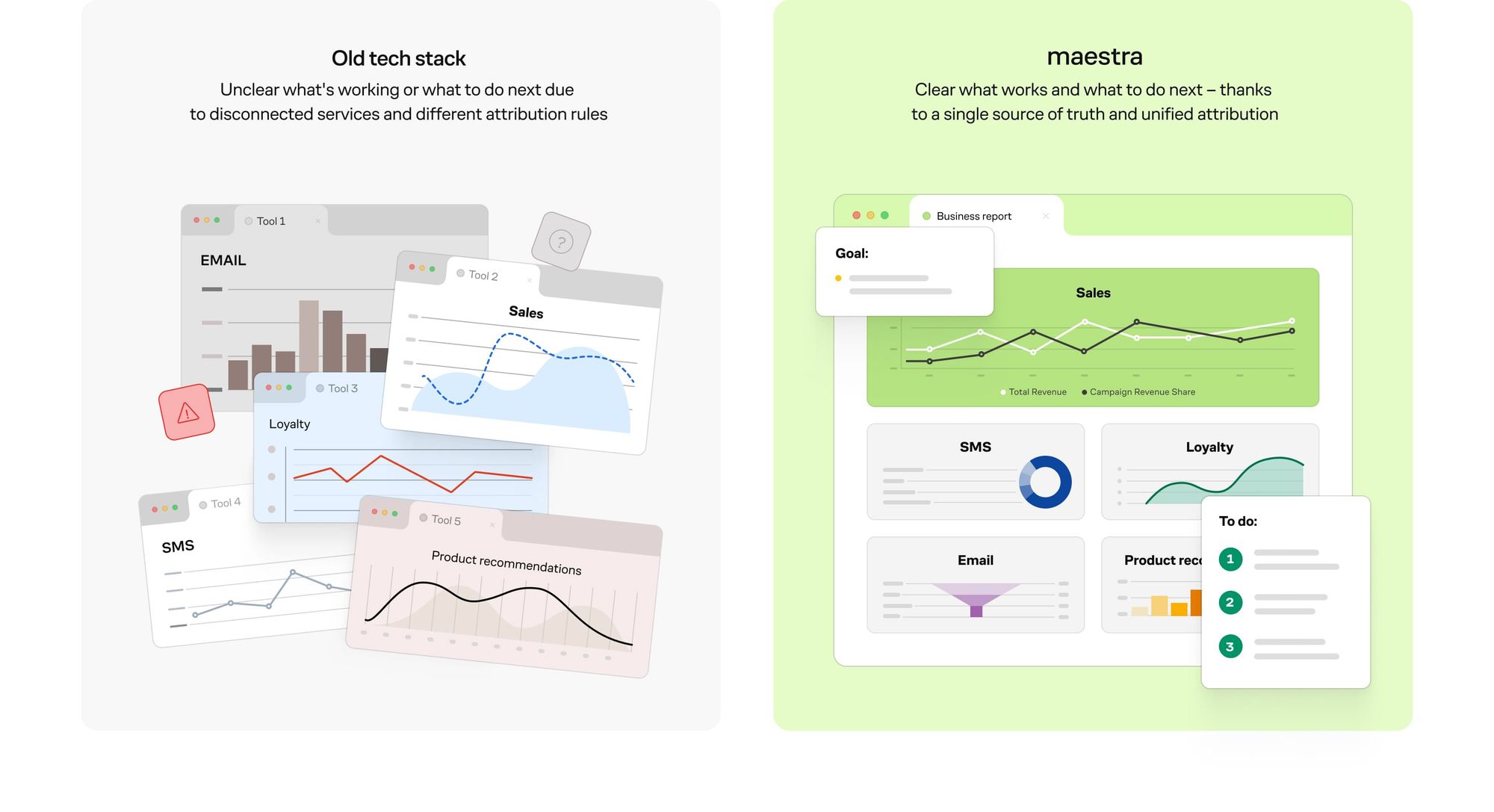
Your attribution numbers do not match your gut
Teams keep hearing that email or SMS drove a sale, then find the reporting behind it inconsistent or inflated. When the tool overstates its own impact, every budget conversation starts from a number nobody trusts.
What we hear from brands
an outdoor gear brand analyzing performance across three systems that feels more complicated than it needs to be
a home heating products retailer that would rather trust one clean report than multiple disparate ones
a made-to-order foam products manufacturer wary of weak reporting and inflated attribution
The new way
Control groups turn correlation into proof
Maestra lets teams create control, or holdout, groups for entire channels, individual campaigns, flows, or promotions. That means incremental lift gets measured directly rather than assumed, so a channel's real contribution is never a guess.
Outcomes brands report
64%
reduction in marketing stack costs
8.9%
campaign-driven revenue increase
22%
repeat domestic revenue growth
Customer proof
Selkirk measures its Meta ads by ROAS, and it grew 2.6x

With Meta costs rising, Selkirk switched its dynamic product ads to Maestra's product cards, which stay current automatically and highlight discounts and new arrivals. Measured against the previous dynamic ads, return on ad spend grew 2.6x while cost per click fell 17%.
2.6x
growth in return on Meta ad spend
-17%
lower cost per click on Meta

“We've tested several dynamic product creative solutions, including Marpipe, and Maestra has been the standout by far.”
How it works
A migration built to protect revenue, not just data
Access and a plan, nothing more
You provide access to your current systems and approve the migration roadmap your forward-deployed marketer puts together.
Parallel systems, zero downtime
Your old stack keeps running the entire time, so there is no gap in sending, tracking, or customer experience.
Warm-up handled before you launch
Deliverability warm-up runs as part of the transition, so your first campaigns on Maestra land in the inbox, not the spam folder.
The platform
Ten modules that were never meant to be separate tools
Site personalization, recommendations, email, SMS, and the rest of Maestra's modules were built to share one commerce-specific data model, not bolted together after the fact. That foundation is what supports 2M RPM at under 300 milliseconds across the platform.
Including
Your forward-deployed marketer
The math behind better support: fewer accounts per person
Most vendors stretch one account manager across 60 or more accounts. Maestra caps forward-deployed marketers at under 15, which is the reason a 5-minute response time and four monthly meetings are even possible.
Fewer than 15 accounts per marketer, versus 60+
5-minute response time versus 72 hours
4 meetings a month versus 1
Replace your stack
The overlap audit that leads to Maestra
Auditing every tool that touches customer data usually turns up several doing the same job. Once that overlap is mapped, one platform can absorb most of it. That is the case Maestra makes against a stack built from separate email, SMS, recommendation, and loyalty tools.
Get a straight answer on fit
Talk to an expert about whether Maestra actually solves what your current stack cannot.